 SC Ecosystems
This Birds-of-a-Feather session will bring together the community around software, research workflows, and AI-enabled scientific computing.
Session Details
- Date and time: Tuesday, November 17, 5:15-6:45 pm CT
- Venue: SC26, Chicago, IL
- Conference program: bof147 / sess379
Co-organizers
- Lois Curfman McInnes, Argonne National Laboratory
- Anshu Dubey, RIKEN R-CCS, Japan
- Dorian Arnold, Emory University
- Prasanna Balaprakash, PrimaLabs
- Mike Bernhardt, Team Libra
- Thomas Herault, INRIA
- Keita Teranishi, Oak Ridge National Laboratory
Moderators
Lightning Speakers
- Stefan Wild, Lawrence Berkeley National Laboratory
- Mary Ann Leung, Sustainable Horizons Institute
- Thomas Herault, INRIA
- Olivia Newton, University of Montana
- Prasanna Balaprakash, PrimaLabs
- More to be announced
Abstract
AI is rapidly reshaping scientific software through code generation, simulation acceleration, intelligent workflows, and emerging agentic systems. Yet the software ecosystems, collaboration models, trust frameworks, and workforce practices that underpin high-performance computing (HPC) were built for a different era. Drawing on findings from a recent workshop series, this BOF invites the international community to challenge assumptions, identify emerging priorities, and help define the next generation of scientific computing ecosystems. Discussion will focus on human-AI collaboration, trust, sustainability, user experience, and workforce evolution, turning shared insights into actionable directions for the community.
Long Description
The HPC community has long enabled scientific discovery at the limits of scale, complexity, and performance. Today, that leadership role is being reshaped by the convergence of AI, increasingly heterogeneous computing platforms, and rapidly evolving software development practices. At the center of this transformation is scientific software, the durable embodiment of domain expertise, computational methods, and collaborative knowledge that enables discovery to scale beyond individual researchers, projects, and institutions.
This Birds-of-a-Feather session invites the international HPC community to help answer a central question: how must scientific computing ecosystems evolve to remain trustworthy, sustainable, and effective in the age of AI?
The discussion will explore how AI is changing not only software development, but also the way research teams collaborate, validate results, build trust, train the next generation of computational scientists, and sustain software over decades. Topics include the evolving roles of research software engineers and domain scientists, human-AI collaboration, software sustainability, workforce development, reproducibility, user experience, organizational models, and cross-disciplinary collaboration.
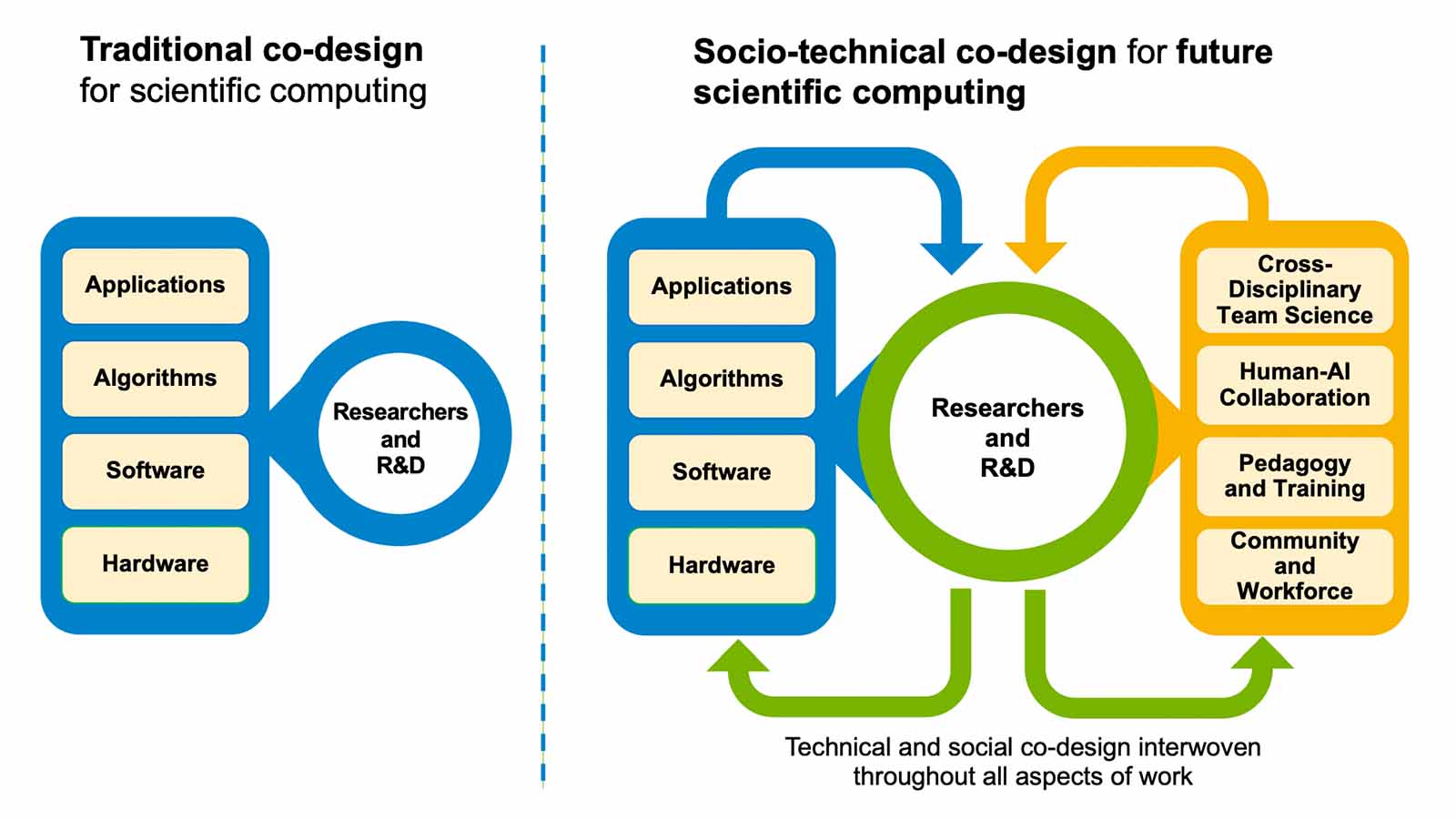
The session builds on a recent workshop series that brought together experts from science, computing, AI, and the humanities to examine the future of scientific software ecosystems. Those discussions were motivated by a convergence of recent community reports on scientific software and AI for science, all pointing toward the same conclusion: technical advances alone will not determine the future of computational science. The ways scientific software is designed, validated, maintained, governed, and taught are undergoing fundamental change.
This BOF is intentionally designed as an interactive community forum. Brief opening remarks will establish a common foundation, but the majority of the session will be devoted to moderated audience discussion. Participants will be invited to share experiences, challenge assumptions, identify emerging priorities, and discuss where current practices are succeeding and where they are falling behind. The objective is to surface perspectives from across laboratories, universities, industry, HPC centers, software projects, and international communities.
This conversation is especially timely. AI-generated code, agentic software development, autonomous scientific workflows, heterogeneous architectures, and increasingly sophisticated data ecosystems are already changing expectations for how scientific software is created, maintained, and trusted. These changes raise important questions about productivity, software quality, reproducibility, governance, workforce preparation, and long-term stewardship. No single institution or discipline has all the answers.
The primary outcome of this BOF will be a community-informed set of priorities and open questions that reflects the collective experience of SC participants. Ideas and recommendations captured during the discussion will help refine the emerging framework, identify opportunities for collaboration, and provide practical starting points for future community initiatives. Most importantly, the session aims to broaden participation in shaping the next generation of scientific software ecosystems, ensuring that the future is informed not only by advances in AI, but also by the collective wisdom of the scientific computing community.
Session Format
This BOF is designed as an interactive, moderated community discussion rather than a sequence of presentations. The session opens with five minutes of framing remarks, followed by 3-minute lightning talks that introduce key themes. Each speaker will conclude with a question to launch audience discussion rather than provide a conclusion. The majority of the session will be devoted to structured audience participation using moderated discussion, live polling, and guided prompts to encourage participation from attendees across disciplines. The moderators will synthesize recurring themes, identify areas of consensus and disagreement, and invite brief responses from the lightning speakers when appropriate. The session will conclude with a summary of community priorities, open questions, and next steps that can inform future collaborations and community initiatives.